Education Software Development Services
Build smarter, more connected learning environments with our custom education software development services. We help K-12 schools, higher education institutions, universities, corporate training providers, and EdTech startups improve student engagement, streamline administrative workflows, enhance remote learning, and drive institutional growth fostering a future-ready educational ecosystem.
Our Array of Education Software Development Services
Aspire SoftServ supports the education sector with custom-built solutions. From individual tutors and private academies to large university systems and government education bodies, we design software that simplifies administration, personalizes learning, strengthens stakeholder communication, and improves operational efficiency. Our goal is to keep your educational institution competitive, compliant, and learner-centric in an increasingly digital world.

Education ERP Development
We build comprehensive ERP systems tailored for educational institutions, integrating admissions, enrollment, student information, faculty management, timetabling, finance, and reporting into a single, unified platform. This ensures accurate data, eliminates departmental silos, streamlines operations, and empowers leadership with data-driven insights for better strategic decision-making, whether for a small private school or a multi-campus university.

Student Information System (SIS) Development
Managing student data is at the core of educational administration. Our SIS solutions provide a centralized database for demography, attendance, grades, disciplinary records, health information, and more. We ensure secure, role-based access for administrators, teachers, students, and parents, simplifying record-keeping, enhancing communication, and providing a 360-degree view of the student journey.

Virtual Classroom & Remote Learning Solutions
We design and develop feature-rich virtual classroom software that brings the interactive experience of a physical classroom online. Our solutions include real-time video conferencing, interactive whiteboards, screen sharing, breakout rooms, attendance tracking, and live polling. This ensures continuity of education, expands geographical reach, and provides flexible learning opportunities for all.

Learning Management System (LMS) Development
Our LMS platforms facilitate the creation, delivery, tracking, and management of educational courses and training programs. We develop robust systems that support blended and fully online learning, featuring content management, interactive assessments, discussion forums, gradebooks, and progress analytics. This enables educators to deliver compelling content and helps learners achieve their goals flexibly and efficiently.

Admission & Enrollment Management System
We develop solutions that streamline the entire student recruitment and onboarding lifecycle. From inquiry management and online application portals to document submission, fee payment, and cohort selection, our systems automate tedious tasks, reduce administrative overhead, improve the applicant experience, and provide analytics to optimize recruitment strategies.

Education Software Modernization & Integration
Outdated, disparate systems can cripple institutional agility and innovation. We modernize legacy education software with advanced features, cloud-native scalable infrastructure, and improved security protocols. Our approach ensures seamless integration between new and existing systems (e.g., integrating an SIS with an LMS or a library management system), helping institutions adopt smarter processes, improve data accuracy, and stay competitive.
Types of Education Software We Develop
We design and develop specialized software that addresses the unique challenges of educators, administrators, students, and parents. Our solutions cover the entire education lifecycle from recruitment and learning to assessment and alumni relations helping institutions operate with greater efficiency, insight, and impact.
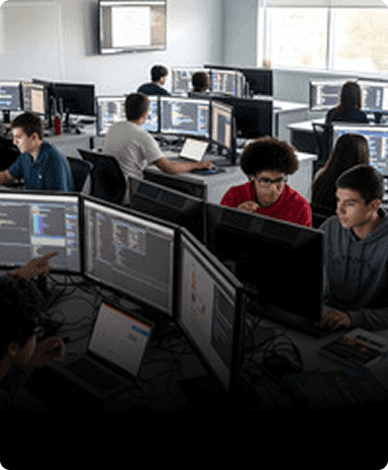





Custom Software Solutions for Every Education Segment
We deliver specialized software solutions designed to optimize operations and learning outcomes across every segment of the education ecosystem. From early childhood education to professional upskilling, our custom software ensures improved engagement, efficiency, and scalability.

K-12 Schools & Districts
Our experts design scalable solutions for primary and secondary education, supporting curriculum planning, standardized testing, parent portals, and district-wide reporting to improve student outcomes and operational transparency.

Higher Education & Universities
We build comprehensive platforms for colleges and universities, encompassing admissions, CRM, course catalog management, research administration, alumni relations, and campus services.

Vocational & Technical Training Institutes
Our tailored solutions support skill-based training providers with competency tracking, hands-on learning modules, industry certification integration, and job placement management.

Corporate Learning & Development
We develop corporate LMS and training platforms for employee onboarding, compliance training, leadership development, and skills management, often integrated with HR systems.

EdTech Startups & Online Academies
Our platforms help budding EdTech ventures and MOOC providers launch scalable, market-ready learning products with custom features, monetization models, and analytics.

Tutoring & Test Prep Centers
We design solutions for tutoring businesses to manage schedules, student progress, billing, and online lesson delivery through virtual classrooms and digital whiteboards.

Government & Public Education Bodies
We build systems for educational authorities to manage funding, policy implementation, standardized testing data, and performance analytics across multiple institutions.

Language Learning Platforms
Our experts create engaging apps and platforms for language acquisition, featuring speech recognition, interactive exercises, and cultural immersion content.

Library Management Systems
We develop software for digital and physical library management, including cataloging, circulation, patron management, and integration with online research databases.
Want to accelerate software development at your company ? See how we can help.
Why Choose Aspire for Your Education Technology Needs
With a deep understanding of educational workflows and challenges, we deliver tailored solutions that integrate seamlessly across teaching, learning, and administration. Benefit from compliant, secure, and pedagogically sound technology designed to empower educators, engage learners, and streamline institutional management.
Personalized Learning Pathways
As a trusted education technology partner, we build solutions that adapt to individual learner needs. By leveraging data on learning pace, style, and performance, our systems can recommend content, adjust difficulty, and provide targeted support, ensuring each student can achieve their full potential and reducing the risk of learning gaps.
Administrative Workflow Automation
Our education solutions streamline complex administrative processes such as enrollment, scheduling, grading, and reporting. Automated workflows and centralized data reduce manual errors, free up valuable time for educators and staff, and ensure that institutional operations run smoothly and efficiently.
Data-Driven Institutional Intelligence
We deliver advanced analytics and reporting systems tailored for education leaders. Institutions can gain deep insights into student performance, enrollment trends, instructor effectiveness, and financial health. This enables proactive intervention, strategic planning, and demonstrable ROI on educational initiatives.
Seamless Stakeholder Collaboration
Our platforms break down communication barriers between teachers, students, parents, and administrators. With shared dashboards, messaging systems, and progress portals, we foster a collaborative ecosystem where everyone is informed, engaged, and working towards the common goal of student success.
Scalability & Accessibility
We provide cloud-based solutions that can scale effortlessly from a single classroom to an entire district or global student body. Our platforms are built with accessibility at their core, ensuring compliance with standards like WCAG to provide equitable learning experiences for all users, including those with disabilities.
Compliance & Data Security
Educational institutions handle highly sensitive data and must comply with strict regulations like FERPA, GDPR, and COPPA. Our solutions incorporate robust security measures, role-based access controls, audit trails, and data encryption, ensuring student privacy is protected and institutional compliance is maintained.
Case Studies: Real-World Success Stories
See how AspireSoftserv has helped organizations across industries use technology solutions to improve their business results, lower costs, and achieve meaningful growth.

HRIS Configuration Optimization Suite
A centralized HRIS/HCM configuration platform delivering automation, compliance, and real-time monitoring for enterprise-scale human capital management systems.
Key Features

60% Faster Configuration Management
90%+ Operational Efficiency Achieved
35% Revenue Growth in First Quarter
25% Faster User Adoption in 6 Months

ELearning Management System
A secure, kid-friendly Android learning device delivering personalized content, real-time updates, and distraction-free study sessions for improved academic performance.
Key Features
40% Boost in Student Focus During Learning Sessions
35% Improvement in Overall Academic Performance
100% Controlled, Distraction-Free Access to Learning Content
5 Dedicated Learning Apps Built for Personalized Education

AI-Driven Literature Tagging and Research Platform
AI-powered academic research platform helping researchers, publishers, and enterprises to search, compile, and reuse knowledge from millions of scanned pages.
Key Features
65% Faster Access to Relevant Content
40% Reduction in Redundant Searches
90%+ OCR Accuracy Across 1.4M+ Pages
2M+ AI-Generated Tags Processed with High Contextual Accuracy

Software Solution for Wireless Connectivity Provider
A secure, education software development solution enabling safe browsing for students with full parental and school control.
Key Features
45% Reduction in Technical Support Requests
50% Faster Device Provisioning for Schools
60% Improvement in Policy Compliance Across Users
100% Reliable Connectivity for Students at School, Home & During Transit

HRIS Automated Service Updates & Release Management
Automated and intelligent cloud-based platform that helps to minimize HRIS/HCM applications release management, manual effort, improve compliance, and deliver real-time visibility for global enterprises.
Key Features
25% Faster User Adoption
90%+ Operational Efficiency
35% Increase in Revenue
70+ Enterprise Clients Including Fortune 500
Advanced Technologies Redefining Education
Our custom education solutions leverage cutting-edge technologies to empower institutions, educators, and learners with immersive, efficient, and personalized experiences. By integrating these digital innovations, educational organizations can future-proof their offerings, improve outcomes, and remain adaptive to the evolving landscape of learning.
Artificial Intelligence (AI) & Machine Learning

Artificial Intelligence (AI) & Machine Learning
AI personalizes learning by recommending content, automating grading for objective answers, and identifying at-risk students through predictive analytics. AI-powered chatbots provide 24/7 student support, answering FAQs and guiding users through administrative processes, thereby enhancing engagement and operational efficiency.
Adaptive Learning Technologies

Adaptive Learning Technologies
hese systems use AI to continuously adjust the path and pace of learning based on individual student performance and interactions. By presenting challenges that are appropriately difficult, they maximize learning efficiency, boost confidence, and ensure mastery of concepts before moving on.
Learning Analytics & Big Data

Learning Analytics & Big Data
Advanced analytics tools process vast amounts of data from LMS, SIS, and other platforms to uncover insights into learning patterns, engagement levels, and institutional effectiveness. This data-driven approach informs curriculum development, teaching strategies, and resource allocation.
Virtual Reality (VR) & Augmented Reality (AR)

Virtual Reality (VR) & Augmented Reality (AR)
VR creates immersive simulated environments for experiential learning (e.g., virtual lab experiments, historical site tours). AR overlays digital information onto the real world (e.g., interactive 3D models in a textbook), making abstract concepts tangible and dramatically increasing student engagement and retention.
Gamification

Gamification
By incorporating game design elements like points, badges, leaderboards, and challenges into learning activities, gamification boosts motivation, increases participation, and makes the process of education more enjoyable and rewarding for learners of all ages.
Blockchain

Blockchain
Blockchain technology offers secure, tamper-proof credentialing and record-keeping. It can be used to issue digital diplomas, certificates, and micro-credentials that are instantly verifiable by employers or other institutions, reducing fraud and simplifying transfer processes.
Cloud Computing

Cloud Computing
Cloud-based educational platforms provide ubiquitous access to learning materials and tools from any device, anywhere. They offer unparalleled scalability, reduce IT infrastructure costs for institutions, and facilitate seamless collaboration among globally dispersed students and faculty.
Internet of Things (IoT)

Internet of Things (IoT)
IoT devices create smart campuses and classrooms. Sensors can monitor attendance automatically, optimize energy use in buildings, track library books, and enhance campus security, leading to more efficient and sustainable institutional management.
Natural Language Processing (NLP)

Natural Language Processing (NLP)
NLP powers language learning apps, provides feedback on essay structure and grammar, and enables sophisticated plagiarism detection tools. It makes learning languages more interactive and helps uphold academic integrity.
Hear from our clients

Client praised the team’s adaptability, expertise, and responsiveness.
The team was highly adaptable and knowledgeable throughout the partnership, much to the client's delight and complete satisfaction. The team was highly responsive, and internal stakeholders were particularly impressed with their deep experience and diverse service offerings.

Sunit Sushil
Manager Customer Excellence at Abzooba Inc
Client praised Aspire’s skill, speed, and professionalism.
Excellent developer skills and professionalism. Aspire was able to meet deadlines with short notice, communicate efficiently with team members on multiple tasks, produce precision functions, and quickly solve our dysfunction within our website. Will definitely hire them again.

Julie Brown
President of Fenix Net Solutions
Client trusts Aspire for quality, agility, and Liferay expertise.
Since 2015, the client has been satisfied with Aspire SoftServ Pvt. Ltd.'s excellent performance. They use agile methodologies, delivering quality design work that has surprised the internal stakeholders. Moreover, they stand out for their skilled resources, who have great expertise in Liferay.

Tony Haux
Chief Compliance Officer



Building a Robust and Versatile Technology Stack
At Aspiresoftserv, we build reliable software solutions using a carefully chosen set of modern technologies. Our approach focuses on creating scalable, secure, and high-performing applications that meet the unique needs of every business. We combine proven tools and best practices to deliver smooth, efficient experiences for users and businesses alike.
- Frontend
- Backend
- Mobile
- Cloud & DevOps
- Database


Our Agile Roadmap for Seamless Education Software Development
Our agile roadmap ensures education software is built step by step with clear goals, user feedback, and continuous improvements. From discovery to full launch, every stage focuses on making the platform practical, user-friendly, and adaptable to real classroom needs. This structured yet flexible process helps schools adopt technology smoothly while supporting teachers, students, and administrators effectively.
Discovery & Pedagogical Alignment
We structure agile sprints to deeply understand your institutional goals, pedagogical approach, and user needs (administrators, teachers, students, parents). This ensures the solution is not just technologically sound but also aligned with educational best practices and learning theories, forming a solid foundation for development.
Core Platform Architecture & UX Design
Agile cycles focus on designing an intuitive, accessible, and engaging user experience for all user roles. We architect a scalable and secure technological backbone, selecting the right stack and frameworks to support robust performance, future expansions, and integration capabilities with existing systems.
Feature Development & Integration
Objectives are defined for developing core modules (e.g., course authoring, gradebook, attendance). Agile sprints ensure iterative building, testing, and refinement of features. A key focus is on seamless integration with necessary third-party systems, such as video conferencing APIs, payment gateways, or student information databases.
Quality Assurance & Accessibility Testing
Every sprint integrates rigorous QA testing functional, performance, security, and most critically, usability and accessibility testing. We ensure the platform is intuitive for its diverse user base and compliant with accessibility standards (e.g., WCAG), guaranteeing an equitable experience for all learners.
Pilot Deployment & Training
Deployment begins with a controlled pilot group. We provide comprehensive training and support materials for administrators, instructors, and support staff. Feedback from this phase is crucial for identifying any final adjustments before a full-scale rollout, ensuring smooth adoption and minimizing disruption.
Full Launch & Continuous Improvement
Post full launch, we enter a cycle of continuous improvement. Agile cycles adapt to user feedback, emerging educational trends, new technological possibilities, and evolving regulatory requirements. This ensures the platform remains relevant, effective, and a valuable asset for years to come.
Discovery & Pedagogical Alignment
We structure agile sprints to deeply understand your institutional goals, pedagogical approach, and user needs (administrators, teachers, students, parents). This ensures the solution is not just technologically sound but also aligned with educational best practices and learning theories, forming a solid foundation for development.
Core Platform Architecture & UX Design
Agile cycles focus on designing an intuitive, accessible, and engaging user experience for all user roles. We architect a scalable and secure technological backbone, selecting the right stack and frameworks to support robust performance, future expansions, and integration capabilities with existing systems.
Feature Development & Integration
Objectives are defined for developing core modules (e.g., course authoring, gradebook, attendance). Agile sprints ensure iterative building, testing, and refinement of features. A key focus is on seamless integration with necessary third-party systems, such as video conferencing APIs, payment gateways, or student information databases.
Quality Assurance & Accessibility Testing
Every sprint integrates rigorous QA testing functional, performance, security, and most critically, usability and accessibility testing. We ensure the platform is intuitive for its diverse user base and compliant with accessibility standards (e.g., WCAG), guaranteeing an equitable experience for all learners.
Pilot Deployment & Training
Deployment begins with a controlled pilot group. We provide comprehensive training and support materials for administrators, instructors, and support staff. Feedback from this phase is crucial for identifying any final adjustments before a full-scale rollout, ensuring smooth adoption and minimizing disruption.
Full Launch & Continuous Improvement
Post full launch, we enter a cycle of continuous improvement. Agile cycles adapt to user feedback, emerging educational trends, new technological possibilities, and evolving regulatory requirements. This ensures the platform remains relevant, effective, and a valuable asset for years to come.
Let’s connect
Fill out the form, and we’ve got you covered.
Book a call or fill out the form below and we’ll get back to you once we’ve processed your request.
What happens next?
Our expert will follow up after reviewing your needs.
If required, we’ll sign an NDA to ensure privacy.
Our Pre-Sales Manager will send you a proposal.
Contact us
Our team would love to hear from you.
Frequently Asked Questions
What is an Education ERP and how does it differ from a standard SIS or LMS?
Education ERP is a comprehensive system that integrates all institutional operations—finance, HR, procurement, asset management, and student services—into a single platform. A Student Information System (SIS) is a core component of an ERP, focused specifically on student data. A Learning Management System (LMS) is focused on the delivery and management of instructional content. An ERP provides the strategic backbone, while an SIS and LMS are specialized tools that often integrate with it.
How does technology integration improve student learning outcomes?
Technology integration supports differentiated and personalized instruction, provides immediate feedback through interactive assessments, and offers access to a wealth of digital resources. Tools like analytics help identify struggling students early, allowing for timely intervention. Furthermore, collaborative technologies and multimedia content can make learning more engaging and effective, catering to diverse learning styles.
What are the key considerations for ensuring data privacy in education software?
Key considerations include strict adherence to regulations like FERPA (US) and GDPR (EU), implementing role-based access controls so users only see necessary data, using robust encryption for data at rest and in transit, conducting regular security audits, and providing clear transparency to users about how their data is collected and used. Vendor selection should prioritize those with strong security certifications and a clear commitment to privacy.
Can custom software help with remote and hybrid learning models?
Absolutely. Custom software is ideal for creating a unified experience for remote and hybrid learning. It can seamlessly blend synchronous elements (like virtual classrooms) with asynchronous learning (recorded lectures, discussion boards). A custom platform can be tailored to an institution's specific hybrid workflow, ensuring all students, whether in-person or remote, have equitable access to resources and instruction.
How can educational institutions measure the ROI of custom software development?
ROI can be measured through both quantitative and qualitative metrics. Quantitatively: reduced administrative costs through automation, increased enrollment via improved recruitment systems, higher student retention rates, and time saved for educators. Qualitatively: improved student and teacher satisfaction, enhanced institutional reputation, better learning outcomes, and greater agility in adapting to new educational challenges.
What future trends should educational institutions be preparing for with their technology?
Institutions should prepare for the growing importance of AI-driven personalization, micro-credentialing and alternative pathways, immersive learning with AR/VR, a greater focus on data privacy and ethics, and the need for interoperable systems that can easily share data. Investing in a flexible, scalable technology foundation now is crucial for adapting to these future trends.