


The enterprise resource planning landscape is evolving rapidly, and Odoo has positioned itself at the forefront of this transformation. As one of the world's most widely adopted open-source ERP platforms, Odoo serves millions of users across diverse industries, delivering a fully integrated suite that encompasses CRM, accounting, inventory management, manufacturing, eCommerce, and human resources in one cohesive system.
Now, as we approach early 2026, attention is turning to Odoo 20, expected to launch in October following the platform's established annual release pattern. While Odoo traditionally maintains confidentiality around specific features until their official unveiling at the Odoo Experience conference, market trends, partner ecosystem insights, and the platform's developmental trajectory offer substantial clues about what businesses can expect from this significant release.
What makes Odoo 20 particularly noteworthy isn't just expanded features or interface refinements.it represents a fundamental evolution in how ERP systems function within modern organizations. The focus is shifting from reactive automation to proactive intelligence that learns from business patterns, anticipates needs, and recommends strategic actions
Why Odoo ERP Matters for Modern Businesses?
Odoo has established itself as a comprehensive business management platform that breaks the traditional mold of expensive, inflexible enterprise software. At its core, Odoo is a fully integrated suite of business applications covering every operational need from customer relationship management and sales to accounting, inventory, manufacturing, human resources, and eCommerce. What makes it particularly compelling is its modular architecture, allowing businesses to start with what they need and expand as they grow.
The platform operates on two editions that serve different business requirements. The Community edition provides open-source access to core functionality, giving businesses complete control over their deployment and customization without licensing fees. The Enterprise edition builds on this foundation with advanced features, enhanced support, and sophisticated modules designed for complex operations. This dual approach democratizes enterprise-grade capabilities while offering premium options for organizations requiring additional power.
Odoo's reach spans virtually every industry globally. Manufacturing companies use it for production planning and quality control. Retail businesses leverage its point-of-sale and inventory management. Professional services firms rely on its project management and timesheet capabilities. eCommerce operations benefit from its integrated online store functionality. This versatility across sectors demonstrates why continuous innovation matters businesses need ERP systems that evolve with changing operational demands, emerging technologies, and shifting market conditions rather than remaining static.
Expected Release Timeline of Odoo 20
Odoo follows a predictable annual release cycle that businesses have come to rely on for planning their technology roadmaps. Based on historical patterns spanning the last several versions, major releases consistently arrive in October, unveiled at the Odoo Experience conference in Belgium. This event serves as the official launch platform where Odoo showcases new capabilities, demonstrates innovations, and makes both Community and Enterprise editions available for deployment.
The progression from announcement to production-ready stability typically spans several phases. Beta versions emerge in the months preceding the conference, allowing technical partners and early adopters to test functionality and provide feedback. Following the official launch, initial versions become available, though most organizations wait for the first maintenance releases that address issues discovered during early real-world implementation. For Odoo 20, businesses should anticipate availability in late October 2025, with production-ready stability by December 2025 or January 2026.
| Version | Release Period | Launch Event Details |
|---|---|---|
| Odoo 17 | October 2023 | Odoo Experience 2023, Brussels |
| Odoo 18 | October 2024 | Odoo Experience 2024, Brussels |
| Odoo 19 | October 2025 | Odoo Experience 2025, Brussels |
| Odoo 20 | October 2026 (Expected) | Odoo Experience 2026, Brussels (Expected) |
What's Driving the Odoo 20 Upgrade?
This release isn't happening in a vacuum. There are real business pressures driving these improvements.
AI is everywhere now: Businesses want systems that do more than just store data. They want predictions, recommendations, and automated workflows. Odoo 20 is responding to that demand by embedding AI capabilities more deeply across the platform.
Enterprise scalability matters: As businesses grow, their ERP needs to keep up. What works for a 50-person company might struggle when you hit 500 employees or expand across multiple countries. Odoo 20 addresses this with better performance architecture and more robust data handling.
Compliance is getting complex: Tax laws, financial regulations, data privacy requirements. They're all getting more complicated, and they vary by region. Modern ERPs need to handle this complexity without requiring constant manual updates.
Everyone wants automation: Manual data entry, repetitive approvals, routine calculations. These are exactly the kinds of tasks that should be automated. Odoo 20 is pushing harder on intelligent automation that learns from patterns and suggests actions.
Odoo 20 Feature Roadmap: Expected Innovations Across Key Modules
Let's get into the specifics. Here's what we're expecting based on roadmap discussions and early information.
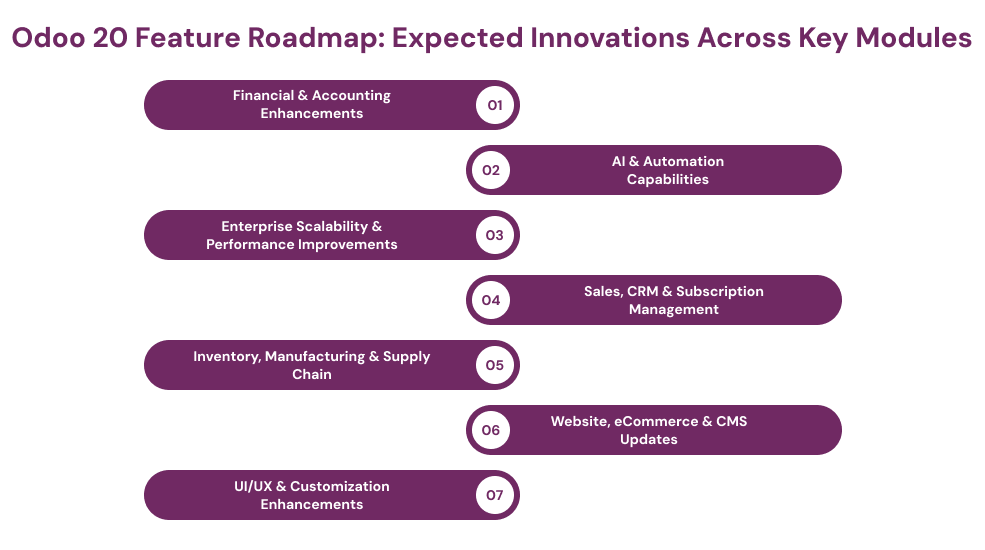
5.1 Financial & Accounting Enhancements
Finance teams live in their ERP systems. Odoo 20 is bringing improvements that should make their lives considerably easier.
Native financial forecasting means you'll be able to project cash flow, revenue, and expenses directly within Odoo without exporting data to spreadsheets. The system will use historical patterns and current trends to give you forward-looking insights.
Improved bank reconciliation is getting smarter matching algorithms. The system will learn from your past reconciliations and suggest matches more accurately, reducing manual review time.
Advanced tax and compliance reporting addresses the growing complexity of multi-jurisdiction operations. Expect better support for region-specific tax rules, automated compliance checks, and easier report generation for government filings.
5.2 AI & Automation Capabilities
This is where Odoo 20 really differentiates itself from previous versions.
Embedded AI across modules means intelligence isn't just bolted on. It's woven into how different parts of the system work. Sales can get next-best-action recommendations. Inventory can predict stockouts. HR can identify patterns in employee satisfaction.
Agent-based automation workflows represent a shift from simple if-then rules to more intelligent process automation. These agents can handle multi-step processes, make contextual decisions, and learn from outcomes.
Intelligent recommendations will surface throughout the interface. When you're creating a quote, the system might suggest optimal pricing based on customer history and market conditions. When planning production, it might recommend scheduling adjustments to optimize resource utilization.
5.3 Enterprise Scalability & Performance Improvements
Performance improvements might not be flashy, but they matter tremendously for growing businesses.
Read-replica database architecture is a technical improvement with practical benefits. It means read-heavy operations (reports, dashboards, searches) can happen on separate database copies without slowing down transactional operations. For users, this means faster reports and more responsive interfaces.
Performance optimization for large datasets addresses a common pain point. As your database grows, some operations can slow down. Odoo 20 includes optimizations specifically designed to maintain performance even with millions of records.
Improved offline and synchronization capabilities matter for field operations. Sales reps, technicians, and warehouse workers often work in areas with spotty connectivity. Better offline support means they can keep working, with changes syncing automatically when connection is restored.
5.4 Sales, CRM & Subscription Management
Sales and customer management are getting more sophisticated.
Advanced pricing and discount logic allows for more complex pricing strategies. Volume discounts, time-based pricing, customer-specific rates, promotional overlays all managed within a unified pricing engine.
Frame agreements and subscription consolidation help businesses managing recurring revenue. You can set up master agreements with customers and then create multiple subscriptions under those agreements, all tracked and billed correctly.
Better customer lifecycle tracking gives you visibility into the entire customer journey. From first contact through multiple renewals, you can see patterns, predict churn risk, and identify upsell opportunities.
5.5 Inventory, Manufacturing & Supply Chain
Supply chain operations are getting smarter and more proactive.
Predictive inventory replenishment uses historical sales data, seasonal patterns, and lead time variability to suggest optimal reorder points and quantities. This reduces both stockouts and excess inventory.
Mixed pallets and advanced packaging support addresses a real operational need. Many businesses ship products with different SKUs on the same pallet or in the same container. Odoo 20 handles this complexity better, with proper tracking and logistics management.
Improved demand forecasting combines statistical models with business intelligence. It can factor in promotions, seasonal variations, and external trends to give you more accurate demand predictions.
5.6 Website, eCommerce & CMS Updates
Your website and online store are critical channels. Odoo 20 improves both functionality and performance.
Independent language translations make managing multilingual sites much easier. Previously, translations were tied more tightly to the core content. Now you have more flexibility to manage different language versions independently.
Improved SEO and page performance includes better meta tag management, structured data support, and faster page loading through optimization techniques. These improvements help your site rank better and convert more visitors.
Enhanced eCommerce workflows streamline the online buying experience. Better checkout flows, improved product configuration for complex items, and smarter inventory visibility for online shoppers.
5.7 UI/UX & Customization Enhancements
Interface improvements make daily work more pleasant and efficient.
Improved user interface consistency means less confusion when moving between modules. Common actions work the same way regardless of where you are in the system.
Low-code / no-code customization improvements let business users make more changes without developer help. Create custom fields, modify views, adjust workflows all through visual interfaces rather than code.
Enhanced mobile and PWA experience recognizes that people work from phones and tablets. The mobile experience is getting more capable and more responsive, with progressive web app features that make it feel more like a native app.
Industry-Wise Benefits of Odoo 20
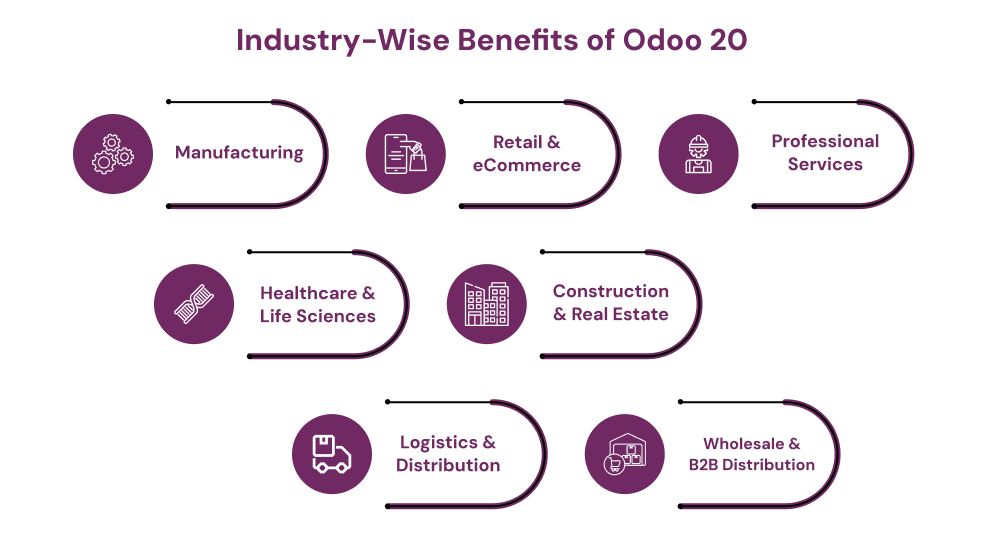
Different industries will see different value from these updates. Let's look at how Odoo 20 helps specific sectors.
6.1 Manufacturing
Smarter Production Planning The system suggests optimal production schedules by simultaneously considering machine availability, material constraints, workforce capacity, and delivery commitments, reducing manual effort while improving on-time delivery and resource utilization rates.
Reduced Inventory Waste More accurate demand forecasting and precise material planning orders components when needed rather than carrying excessive safety stock, directly impacting profitability through reduced obsolescence and lower carrying costs.
Better Cost Control Real-time visibility into actual production costs versus estimates allows immediate identification of variances, enabling managers to intervene quickly when costs spike or efficiency drops below targets.
6.2 Retail & eCommerce
Real-Time Inventory Visibility Synchronized inventory data across all sales channels prevents overselling, ensures customers see accurate stock levels, and helps purchasing teams understand true positions for smarter replenishment decisions.
Improved Customer Experience Faster page loads, accurate product information, streamlined checkout processes, enhanced configuration tools, and reliable order tracking reduce support inquiries and build loyalty through transparency and efficiency.
Smarter Pricing and Promotions Dynamic pricing strategies test different approaches across customer segments, optimize promotional timing using historical performance data, and automatically adjust prices based on inventory or competitive positioning.
6.3 Professional Services
Better Project Costing and Billing Accurate profitability tracking at project level shows which engagements generate healthy margins, while seamless time tracking, expense management, and resource allocation ensure efficient team deployment across concurrent projects.
Subscription-Based Revenue Optimization Consulting firms track utilization against committed hours, manage renewals proactively before expiration, and forecast revenue accurately based on contract pipeline and renewal probability for predictable financial performance.
Resource Utilization Improvements Better visibility into staff assignments, skill demand, and capacity gaps enables smarter staffing decisions, identifies training needs, and reveals utilization trends informing hiring and service offering adjustments.
6.4 Healthcare & Life Sciences
Enhanced Compliance Tracking Automated audit trails, consent management workflows, and documentation tracking help healthcare organizations maintain HIPAA, FDA, and regional health data privacy law adherence while reducing administrative burden.
Patient Data Management Better clinical system integration, secure medical record storage, and automated workflows for appointment scheduling, insurance verification, and billing reduce administrative friction and improve patient service delivery efficiency.
Equipment and Inventory Optimization Predictive replenishment prevents stockouts of critical supplies while minimizing waste from expired inventory through strict expiration tracking, lot traceability for recalls, and regulatory documentation requirements.
6.5 Construction & Real Estate
Project-Based Financial Tracking Visibility into actual costs versus budgets at project level ensures complete cost capture through purchasing, labor, and financial module integration while progress billing aligns revenue recognition with project milestones.
Equipment and Asset Management Construction companies track heavy equipment utilization, schedule preventive maintenance minimizing downtime, and optimize allocation across job sites while real estate firms manage property portfolios and tenant lease tracking.
Subcontractor and Vendor Management Streamlined tracking of subcontractor agreements, vendor certifications, insurance requirements, payment schedules, and compliance documentation simplifies the complex relationships typical in construction project operations.
6.6 Logistics & Distribution
Route Optimization and Delivery Management Intelligent route planning considering delivery windows, vehicle capacity, traffic patterns, and driver schedules improves last-mile efficiency while real-time tracking provides customers and dispatchers visibility for dynamic rescheduling.
Warehouse Operations Enhancement Pick-path optimization reduces travel time, wave planning groups orders efficiently, and putaway strategies position fast-moving items accessibly, directly improving fulfillment speed and labor productivity.
Cross-Docking and Transshipment Support Efficient handling of goods moving through distribution centers without long-term storage is facilitated through improved visibility into inbound and outbound shipments for accurate inventory tracking.
6.7 Wholesale & B2B Distribution
Customer-Specific Pricing and Contracts Sales teams quickly generate accurate quotes reflecting negotiated pricing, volume discounts, payment terms, and product access while maintaining visibility into margin impact and contract compliance requirements.
Multi-Warehouse Inventory Allocation Stock positioning across regional warehouses optimizes based on demand patterns, reducing shipping costs and delivery times while suggesting transfers to balance levels avoiding stockouts and excess inventory.
Sales Rep Territory and Commission Management Performance tracking by territory, commission calculation based on complex rules varying by product line or customer type, and pipeline visibility support direct sales forces and independent representative networks.
Odoo 19 vs Odoo 20: High-Level Comparison
While both Odoo 20 and Odoo 19 share the core philosophy of integrated business management, Odoo version 20 is going to take the charge over going Odoo version 19. Here's how they compare:
| Aspect | Odoo 19 | Odoo 20 |
|---|---|---|
| AI Capabilities | Basic AI integration with chatbot-style assistance | Agentic AI with autonomous task execution |
| Financial Tools | Advanced closing features and improved reporting | Native predictive financial forecasting |
| User Interface | Clean, modern design | More intuitive, personalized user experience |
| Automation | Workflow automation basics | Fully autonomous process management |
| Industry Focus | Core industries covered | Expanded sector-specific solutions |
| Customization | Strong no-code configuration options | Advanced drag-and-drop Studio enhancements |
| Performance | Standard database architecture | Read-replica optimization for large datasets |
| CRM & Sales | Traditional pipeline management | AI-driven recommendations and predictive insights |
| Inventory Management | Standard replenishment rules | Predictive inventory with demand forecasting |
| eCommerce | Functional online store capabilities | Enhanced SEO, independent translations, and faster performance |
Odoo 19 offered rule-based automation and improved UI design. Odoo 20 advances this fundamentally by embedding learning-based AI throughout the platform that adapts recommendations based on business patterns, shifting from static rules to intelligent, adaptive automation.
Odoo 20's read-replica database architecture and dataset optimizations dramatically improve response times for heavy reporting and large transaction volumes. Users managing millions of records get instant insights instead of waiting, with enhanced mobile experience and customization tools reducing developer dependency.
Strategic Steps to Implement Odoo 20
Planning an upgrade properly makes all the difference between a smooth transition and a disruptive implementation. The key to success lies in systematic preparation that addresses technical requirements, organizational readiness, and risk mitigation. Here's how to approach your Odoo 20 implementation strategically.
Evaluate Current Implementation: Document your existing setup by identifying all active modules, custom configurations, and critical integrations. Understanding your current state helps establish realistic expectations and uncovers potential complications before they emerge during the upgrade process.
Plan Your Upgrade Path: Assess whether a direct jump to the latest version or a staged approach makes more sense based on your current version and effort-to-benefit ratio. An experienced Odoo ERP development company can guide you toward the optimal strategy tailored to your business needs.
Stay Informed: Monitor Odoo 20's progress from beta to release by tracking community forums, official announcements, and partner communications. Early adopter feedback surfaces critical issues that get resolved before general availability, helping you make better decisions.
Infrastructure Review: Verify that your hosting environment meets Odoo 20's technical requirements, which may involve upgrading server specs or database configurations. Cloud hosting is increasingly popular for Odoo deployments because it simplifies infrastructure management and enables seamless scaling.
Skill Development: Plan comprehensive training for your team to ensure they understand new features and capabilities relevant to their roles. Designate key users in each department as internal champions who can drive adoption and support their colleagues through the transition.
Find a Certified Odoo Partner: Partner with a qualified, certified Odoo expert who has proven migration experience and relevant industry knowledge. Their familiarity with common pitfalls and best practices makes the upgrade process smoother and helps you avoid costly mistakes.
Test Thoroughly: Set up a test environment that mirrors your production system and run comprehensive tests on critical business processes, integrations, and edge cases before upgrading. Investing in thorough testing prevents expensive problems that would be far costlier to resolve after going live.
Conclusion
Odoo 20 isn't just another software update it's a strategic opportunity to future-proof your business operations. With breakthrough agentic AI, enterprise-grade scalability, and seamless compliance automation, this release eliminates the traditional trade-off between powerful functionality and ease of implementation. Organizations that act now gain first-mover advantages in operational efficiency and market responsiveness.
The countdown to September 2026 has begun, and preparation separates success from struggle. Whether you're outgrowing current systems, frustrated with legacy ERP limitations, or seeking competitive differentiation, Odoo 20 delivers enterprise capabilities without enterprise complexity. Partner with experienced odoo implementers today to ensure you're positioned to leverage these transformative capabilities the moment they launch.
Frequently Asked Questions (FAQs)
https://www.aspiresoftserv.com/odoo-implementation-servicesQ1: When exactly will Odoo 20 be released?
A: Odoo 20 launches at Odoo Experience 2026 (September 24-26, Brussels), with general availability in October 2026 and stable version 20.1 arriving in Q4 2026.
Q2: What is the biggest difference between Odoo 19 and Odoo 20?
A: The shift from reactive AI chatbots to agentic AI that autonomously executes workflows, plus enterprise scalability improvements, native government reporting, and enhanced offline capabilities.
Q3: Should my business wait for Odoo 20 or upgrade to Odoo 19 now?
A: Upgrade Odoo 19 if on version 16 or earlier with significant limitations. Wait for Odoo 20 if evaluating ERP for the first time or your current system is manageable until late 2026.
Q4: Will my existing customizations and integrations work with Odoo 20?
A: Most customizations require review and updates for compatibility. Audit custom modules three to six months before upgrading with certified partners. Many organizations find Odoo 20's native features eliminate previous customization needs entirely.
Q5: How can I prepare my organization for Odoo 20?
A: Conduct comprehensive system audit documenting current setup and pain points. Build ROI business case. Engage certified Odoo partners early for discovery sessions. Organizations beginning six months ahead achieve significantly higher success rates.
Q6: What industries benefit most from Odoo 20's new features?
A: Manufacturing gains advanced MRP; retail achieves omnichannel operations; professional services optimize resources; healthcare ensures compliance; distribution perfects multi-warehouse logistics. AI and automation universally improve efficiency across all industries.